




How Much Does Commercial Battery Storage Cost in the UK?
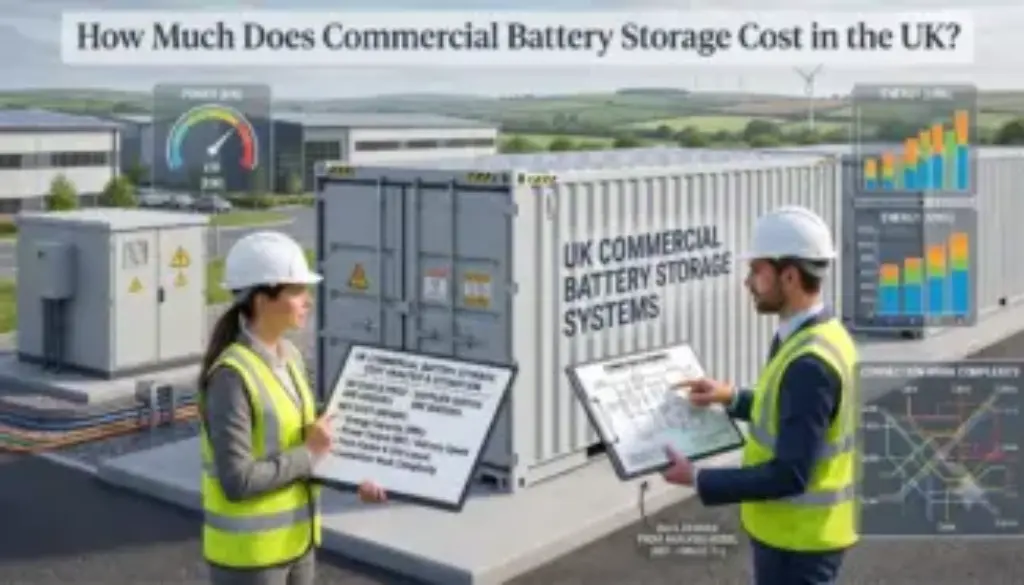
There is no single price for commercial battery storage, and any supplier who quotes one online is guessing. The cost depends on how much energy the system holds, how fast it needs to deliver that energy, the form factor, and the work involved in connecting it to your site. As a rough guide, commercial and industrial systems tend to land somewhere in the region of a few hundred pounds per kWh of installed capacity, with the price per kWh falling as the system gets larger. The only figure that means anything for your business is the one that comes out of a site survey.
This guide explains what drives the price, why the per-kWh number changes so much, and how finance lets the energy savings cover the system rather than your capital budget.
The short answer: cost per kWh and what drives it
Battery storage is usually priced per kilowatt-hour (kWh) of capacity. A small system carries a higher cost per kWh because the fixed parts, the inverter, the controls, the enclosure and the install, are spread across less storage. A large containerised system spreads those same fixed costs across far more capacity, so the per-kWh figure comes down.
That is why a quoted range is wide and why the honest answer is “it depends on your site”. The sections below are the variables that decide where your project sits.
What changes the price
System size (kWh) and power rating (kVA)
Two numbers set the base cost: how much the battery holds (kWh) and how fast it can deliver (kVA or kW). A site that needs to shift a lot of energy slowly has a different price to one that needs short, sharp bursts of high power, even if the headline capacity is the same. Sizing the system to your actual load profile, rather than over-specifying, is the single biggest lever on cost.
Indoor rack, outdoor cabinet or container
The form factor changes the installation cost as much as the hardware.
- An indoor rack system uses space you already have, so site works can be modest.
- An outdoor cabinet needs a concrete pad and groundworks but no building work.
- A containerised system arrives largely pre-built, which keeps on-site labour down even at large scale.
Grid connection and G99 or G100 works
Connecting a battery to the grid involves your Distribution Network Operator and compliance with the G99 and G100 grid codes. The complexity of that connection, and whether your existing infrastructure can take the system as is, can move the total noticeably. This is confirmed during the survey, not before.
Groundworks, cabling and EMS integration
Pad construction, cable runs, switchgear and tying the energy management system into your existing solar, generator and metering all form part of the installed cost. A straightforward site is cheaper than one that needs trenching across a car park.
Total cost of ownership, not just the sticker price
The purchase price is only part of the picture. A system rated for more cycles and backed by a longer warranty costs less over its life, even if it costs more on day one. The Pramac range, for example, is rated to 7,300 cycles and carries a 5 year product and 10 year performance warranty as standard, with the container range covered for 10 years on both. Judge a quote on what it costs per year of useful life, not on the headline number alone.
How the system pays for itself
A commercial battery is unusual among capital purchases because it generates income and savings from the start. There are four routes: cutting peak demand charges, earning Capacity Market payments, getting a better price for your solar, and selling flexibility to the grid. We break these down in how a business battery pays for itself. For most sites, the combination is enough to fund the system over its operating life.
Finance: spreading the cost against the savings
You do not have to find the capital up front. Finance lets you spread the payments across the operating life of the system, with the energy savings funding the repayments. For many businesses that turns a large capital decision into a monthly cost that is offset by what the battery saves. It also protects your capital for the core business. The right structure depends on your books, which is worth discussing alongside the survey.
Frequently asked questions
What is a realistic price range for commercial battery storage? It varies widely with size and site. Expect a per-kWh figure that falls as capacity rises. A proper figure for your project only comes from a site survey, because the connection and groundworks are site-specific.
Why will no supplier quote a flat figure online? Because the same headline capacity can cost very different amounts depending on power rating, form factor, grid connection and groundworks. A flat online price would be misleading.
What makes one system cost more than another? Power rating relative to capacity, the form factor, the complexity of the grid connection, the groundworks, and the cycle life and warranty behind the hardware.
How quickly does it pay back? That depends on your tariff, your solar and which revenue routes you use. Many sites see savings from day one rather than after a fixed payback period.
Can it be financed so there is no capital outlay? Yes. Finance options let the energy savings cover the repayments, so there is no upfront cost.
Generator Pro prices every system from a site survey and offers finance options that let the savings cover the repayments. Get a free site assessment.