




Battery Storage vs Backup Generator: Which Is Right for Your Business?
More UK businesses are looking hard at their backup power. Grid connections are taking longer to secure, energy costs have stayed high, and an unplanned outage can stop a site for hours. Two options come up again and again: a backup generator, or a commercial battery storage system.
Generator Pro supplies both, so this guide compares them fairly rather than steering you towards one. The right answer depends on your site, your loads, and what you want the system to do when the power is on as well as when it is off.
The quick answer
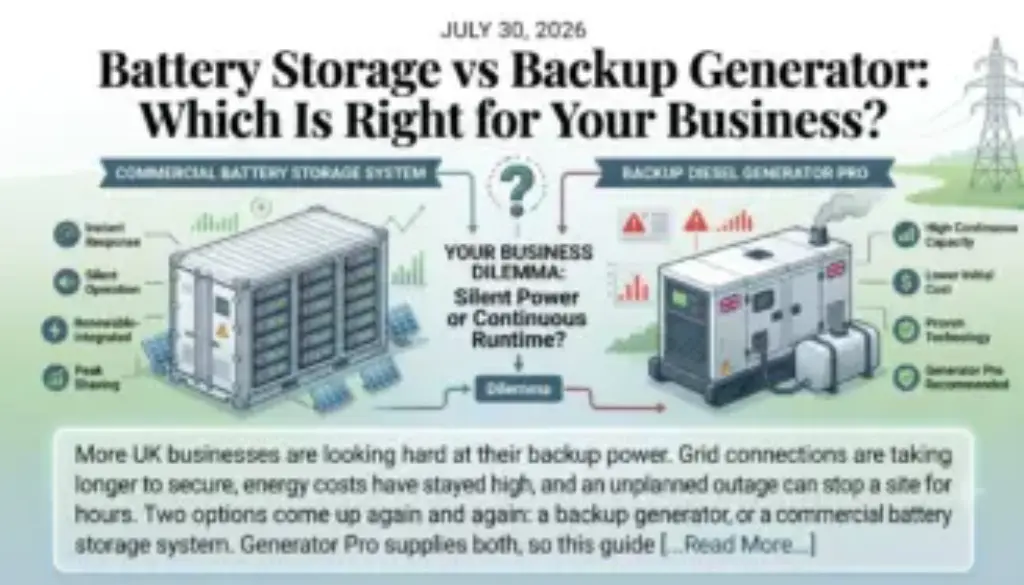
A backup generator is usually the lower upfront cost and will run for as long as you keep feeding it fuel. That makes it strong for long or unpredictable outages, remote sites, and high power demands.
Battery storage costs more to install but gives you silent, instant, zero-emission backup, and it can earn its keep every day by cutting your energy bills. That makes it strong for urban sites, short outages, and businesses held up by a slow or limited grid connection.
Plenty of sites are best served by both. More on that below.
How a backup generator works for business
A backup generator sits on standby and starts when the mains supply drops. Paired with an automatic transfer switch, it can detect the outage and take over the critical load within seconds, then hand back to the grid when the supply returns. You can read more in our guide to how a generator transfer switch works.
For business use the generator is sized around the load you cannot afford to lose, with some headroom for start-up surges. Diesel is the usual choice for standby duty because of its runtime and durability, and larger sites often need a three-phase unit.
Browse commercial options on our power backup generators and three-phase generators pages.
How commercial battery storage (BESS) works
A battery energy storage system, or BESS, is a large rechargeable battery paired with an inverter and a control system. It charges when power is cheap or when your solar is generating, then discharges when grid electricity is expensive or when your site needs more power than its connection can supply.
Most commercial systems use lithium iron phosphate cells for stability and long life, and they come in three main forms: an indoor rack system for a plant room, a weatherproof outdoor cabinet, or a containerised system for large industrial loads. Our guide to what a BESS is explains the parts in more detail.
The important difference is that a generator only earns its place during an outage, while a battery works for you every day.
Head to head
Upfront cost
A generator is almost always cheaper to buy and install for a given power rating. Battery storage costs more up front because you are paying for stored energy capacity as well as the power electronics.
There is no single price for a commercial battery system, and any supplier who quotes one online is guessing. The figure depends on capacity, power rating, form factor, your grid connection and any groundworks. Our post on commercial battery storage cost explains why, and how finance can spread the cost.
Running costs and daily value
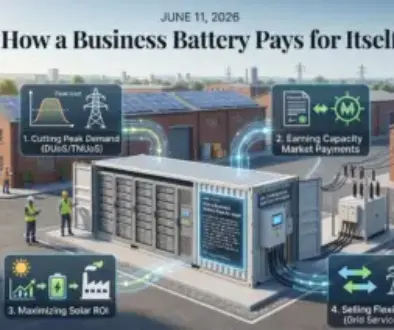
A generator costs money every hour it runs, in fuel and maintenance. A battery can do the opposite and reduce your bills. It can cut peak demand charges, store cheap or solar power for use at expensive times, and earn from grid services. Our guide to how business battery storage pays for itself sets out the routes.
Runtime and capacity
This is where a generator pulls ahead. It will run for as long as you supply fuel, so it suits outages that last many hours or a full day. A battery is limited by its stored capacity. Once it is empty it needs to recharge, so on its own it is better suited to shorter outages or to bridging the gap until a generator starts.
Noise and siting
A battery is silent and produces no exhaust, so it can sit close to people and indoors. A generator makes noise and needs ventilation and a safe location. If noise is a concern, a silenced or silent generator reduces it, and our guide to generator noise regulations explains the rules that apply.
Emissions and planning
A generator burns fuel on site and produces emissions. A battery has no emissions in use, which matters for urban locations, indoor siting and sustainability targets. Both may involve planning and safety requirements depending on size and location.
Maintenance and reliability
A generator has an engine that needs servicing, fuel that needs managing, and it should be exercised regularly so it starts when needed. A battery has fewer moving parts and lower routine maintenance, though it does rely on its cooling and control systems.
When a backup generator is the better choice
- Outages that can last many hours or a whole day
- Remote or off-grid sites with no easy way to recharge a battery
- Events, sites and mobile catering that need power anywhere, where a catering generator fits the job
- High power demands better met by a diesel or three-phase unit
When battery storage wins
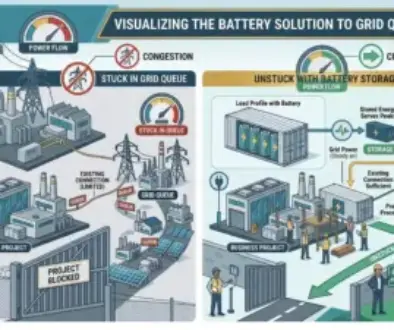
- Your grid connection is slow to arrive or too small, and a battery lets you do more with the supply you have. See our guide to battery storage and grid connection delays
- You want to cut peak demand charges and daily energy costs, not just cover outages
- Your site is in a built-up area where noise and emissions rule out a running engine
- You already have solar and want to store what you generate rather than export it cheaply
Can you use both? Hybrid backup power
For many businesses the strongest setup combines the two. The battery handles instant, silent cover for short outages and does the daily work of cutting energy costs, while the generator provides extended runtime if an outage drags on. The battery bridges the first few seconds and minutes, and the generator takes over for the long haul.
This pairing gives you the daily savings of storage and the endurance of a generator, without relying on either one to do a job it is not suited to.
Getting the right setup for your site
The best choice comes down to your loads, your site and what you want the system to achieve day to day, not just during an outage. If you are weighing up the options, our team can help you size a generator, a battery system, or a combination of both.
Start with the power backup generators range or explore commercial battery storage, and get in touch for a site assessment.