




What Is a BESS? Commercial Battery Storage Explained
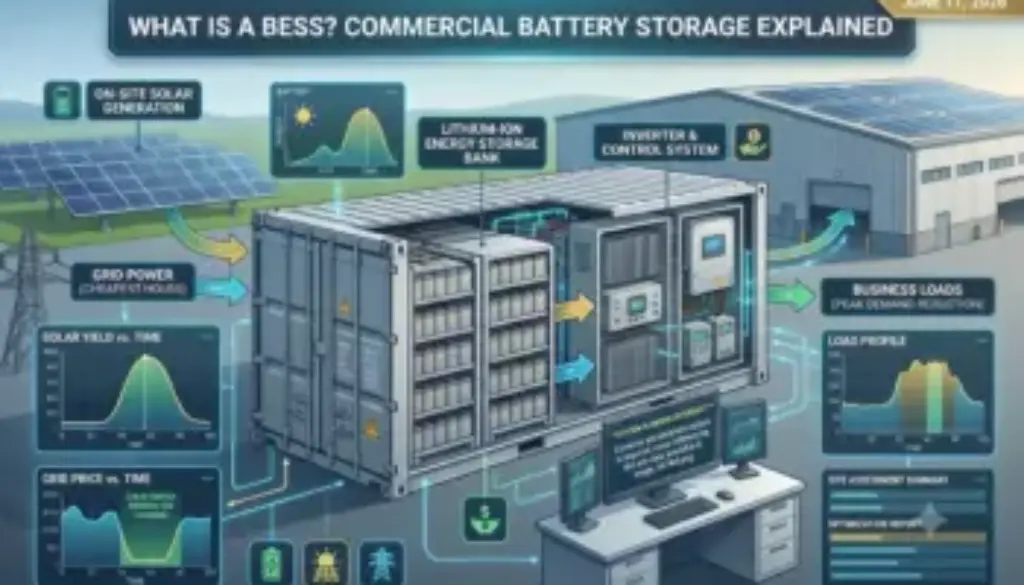
BESS stands for battery energy storage system. It is a large rechargeable battery, paired with an inverter and a control system, that sits on a commercial or industrial site and stores electricity so the business can use it at a better time. The battery charges when power is cheap or when on-site solar is producing, then discharges when grid electricity is expensive or when the site needs more power than its connection can supply. For a UK business, that timing is where the savings come from.
This guide explains what a BESS is, how it works, what companies use it for, and whether it is worth the investment.
What BESS stands for
BESS is simply the industry shorthand for a battery energy storage system. You will also see it written as a battery storage system or grid-scale storage when the systems get large. The principle is the same at every size, from a single rack in a plant room to a shipping container on an industrial pad. Electricity goes in, it is held, and it comes back out when it is most useful.
How a battery energy storage system works
A commercial BESS has four main parts working together.
The core parts: cells, inverter, EMS and enclosure
- Battery cells. These store the energy. Most modern commercial systems, including the Pramac range, use lithium iron phosphate (LFP) cells. LFP is chosen for its stability and long life rather than maximum density, which matters more for a fixed installation than for a car.
- Inverter. Batteries store direct current (DC) while the grid and your equipment run on alternating current (AC). The inverter converts between the two and sets how fast the battery can charge and discharge. This is the difference between energy (kWh, how much the battery holds) and power (kVA or kW, how quickly it can deliver it).
- Energy management system (EMS). This is the brain. It decides when to charge and when to discharge based on your tariff, your solar production and any grid services you take part in. A good EMS runs the whole thing automatically once it is set up.
- Enclosure. The cabinet, rack or container that houses everything, with cooling, heating and fire protection built in.
Charge cheap, discharge expensive: the basic cycle
The simplest way to picture a BESS is a daily cycle. Overnight, when wholesale prices and demand are low, the battery charges. During the afternoon and early evening, when grid electricity is at its most expensive, the battery discharges and the site draws from it instead of the grid. The business buys less power at the worst time of day. Multiply that by every working day and the saving adds up.
What a business uses battery storage for
Cutting peak demand charges
Most UK commercial electricity tariffs charge a premium during a window between 4pm and 7pm on winter weekdays, known as the DUoS red band. Discharging from the battery during those hours moves your draw out of the high-rate band. This is the most reliable saving and it starts on day one.
Getting more value from on-site solar
Without storage, a site exports surplus solar to the grid for a fraction of what it pays to import. A battery holds that energy instead, so the business uses its own cheap solar later in the day rather than buying it back at peak price.
Adding EV charging without a grid upgrade
If you are installing fast chargers, the easy assumption is that you need a bigger grid connection. A battery can buffer the chargers instead, supplying the short peaks from stored energy rather than the incomer. That can mean no Distribution Network Operator (DNO) upgrade and no waiting list.
Riding through outages and grid connection delays
A BESS keeps critical loads running during grid events, and it lets a site add load or get a project commissioned while its grid connection is still in the queue.
Is commercial battery storage worth it?
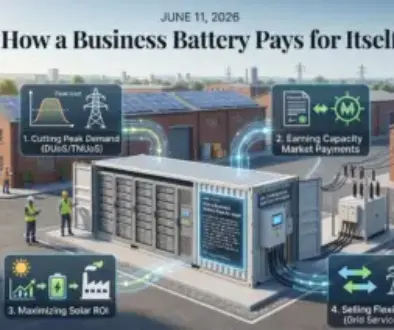
A battery on a UK commercial site has four routes to paying for itself: cutting peak demand charges, earning Capacity Market payments, getting a better return on solar, and selling flexibility back to the grid. Most of these begin the moment the system is switched on rather than after a long payback period. The mix that applies depends on your tariff, whether you already have solar, and whether you choose to enter the Capacity Market.
We explain each of these in detail in our guide to how a business battery pays for itself, and we cover pricing in how much commercial battery storage costs in the UK.
Indoor, outdoor or containerised: which form factor?
A commercial BESS comes in three shapes, and the right one depends on your site rather than your load alone.
- Indoor. A modular rack system for a plant room, spare bay or internal enclosure. Best when you have unused space inside and want to avoid building works or planning issues. See indoor battery storage.
- Outdoor. A weatherproof all-in-one cabinet that drops onto a pad in a yard or car park. Best when the building has no room but the site does. See outdoor battery storage cabinets.
- Containerised. A complete system in a 10ft or 20ft container for large industrial loads, stalled grid connections and energy trading. On site in days. See containerised battery storage.
Frequently asked questions
What does BESS stand for? Battery energy storage system. It is a rechargeable battery with an inverter and control system that stores electricity for a business to use at a better time.
How does a BESS physically work? It charges when power is cheap or solar is producing, holds the energy, and discharges it when grid electricity is expensive or when the site needs more power than its connection provides. An energy management system runs the timing automatically.
What is LFP and why does it matter? LFP is lithium iron phosphate, the battery chemistry used in most commercial systems. It is chosen for stability and long cycle life, which suits a fixed installation that needs to last twenty years or more.
How long does a commercial battery last? Quality systems are rated for thousands of cycles. The Pramac range, for example, is rated to 7,300 cycles, which gives a long operational window when cycled daily.
Does a business need solar to benefit? No. Solar improves the case, but a battery still earns its keep through peak demand savings, Capacity Market payments and flexibility services on a site with no solar at all.
Want to know whether your site is a fit? Generator Pro is an authorised UK Pramac dealer and runs a free site assessment before any commitment. See the Pramac commercial battery storage range.