




Do You Need Planning Permission for Commercial Battery Storage?
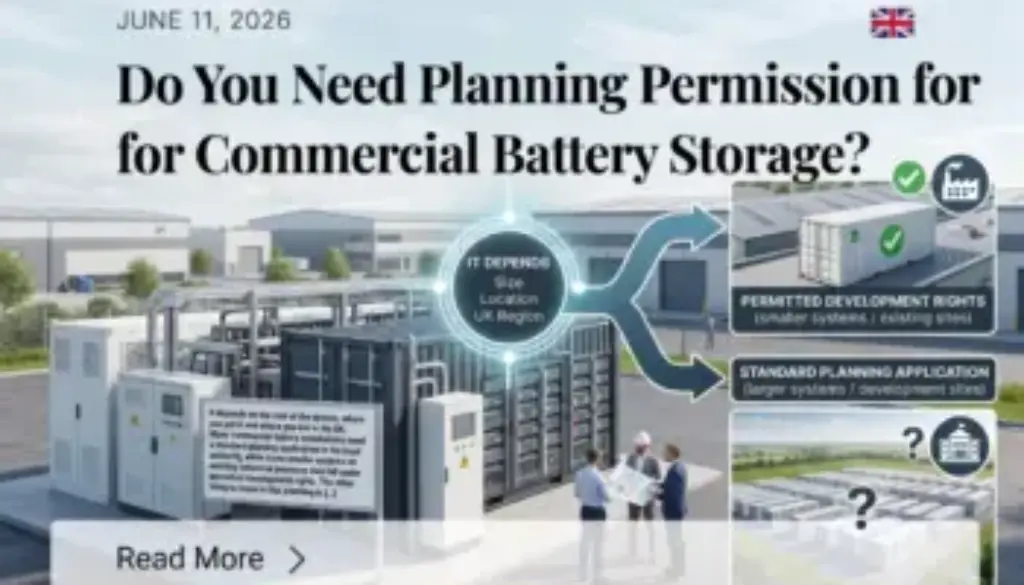
It depends on the size of the system, where you put it and where you are in the UK. Many commercial battery installations need a standard planning application to the local authority, while some smaller systems on existing industrial premises may fall under permitted development rights. The other thing to know is that planning is separate from your grid connection, which has its own approval process. For most sites, the practical answer comes from checking your specific plans with your local planning authority early, before the design is fixed.
This guide explains when permission is usually needed, when it may not be, and what else has to be approved before an outdoor system goes live.
The short answer
There is no blanket rule that battery storage always needs planning permission or that it never does. The deciding factors are the physical size and footprint of the installation, its siting (a quiet corner of a yard is treated differently to a position near a boundary or a sensitive neighbour), and the planning regime where your site sits, because rules differ across England, Scotland, Wales and Northern Ireland. A small cabinet behind an existing industrial building is a very different proposition to a row of containers, and the planning treatment reflects that.
When planning permission is usually required
A full planning application is the common route for commercial battery storage of any meaningful scale, particularly when the system is large, sits in a prominent or sensitive location, or forms part of a wider project such as a solar installation or an energy scheme. If there is any doubt, treating it as a planning matter from the start avoids delays later.
When permitted development rights may apply
Some installations on existing commercial or industrial premises can benefit from permitted development rights, which allow certain works without a full application. This is more likely for smaller systems that are modest in size, sit within the existing site and do not raise issues such as noise or visual impact. Permitted development is not a guarantee, and the rights and limits vary by location and change over time, so it should be confirmed rather than assumed.
What planners look at
When a system does go through planning, the assessment tends to focus on a familiar set of points:
- Siting and visual impact. Where the unit sits and how visible it is from boundaries, roads and neighbours.
- Noise. Cooling and inverters make some noise, so proximity to sensitive uses matters.
- Flood risk. Whether the location is at risk and how the equipment is protected.
- Fire service access. Safe access for emergency services around the installation.
Outdoor systems are designed with these in mind. A weatherproof cabinet that drops onto a pad in a yard or compound is usually straightforward to site sympathetically.
Outdoor cabinets versus containers: how scale changes the process
Scale changes the conversation. An outdoor cabinet sits on a compact pad, roughly 1.3m by 1.4m, and is easy to tuck into a corner of a yard or car park, which tends to make the planning position simpler. A containerised system has a larger footprint and a bigger visual and infrastructure presence, so it is more likely to involve a full application and a more detailed assessment. Neither is a barrier, but the larger the system, the earlier planning should enter the plan.
Other approvals that matter more day to day
DNO grid connection, G99 and G100
It is easy to confuse planning with grid approval, but they are separate. Connecting a battery to the grid means working with your Distribution Network Operator and complying with the G99 and G100 grid codes, which govern how a system connects and how it protects the network. A project can have planning sorted and still need its grid connection arranged, and the reverse is also true. Both need to be in hand before a system goes live, and a good installer manages the grid code work as part of the job.
A practical pre-installation checklist
- Confirm the planning position for your specific site and system size with your local planning authority.
- Establish whether permitted development rights could apply before assuming a full application.
- Identify siting that keeps the unit away from boundaries and sensitive neighbours.
- Check flood risk and fire service access for the proposed location.
- Arrange the DNO grid connection and G99 or G100 compliance in parallel.
- Get a site survey so siting, pad and grid route are confirmed together.
Frequently asked questions
Does a battery cabinet always need planning permission? No. It depends on size, siting and location. Some smaller systems on existing premises may fall under permitted development, while larger or more prominent installations usually need a full application. Confirm with your local planning authority.
What size triggers a full application? There is no single national figure to quote with confidence, and it varies by location and over time. The safe approach is to check your specific plans rather than rely on a threshold.
Does permitted development cover battery storage? It can for some smaller installations on existing commercial sites, but the rights and limits vary and change, so it should be confirmed rather than assumed.
What do planners assess? Typically siting and visual impact, noise, flood risk and fire service access.
Is planning the same as grid connection approval? No. Planning permission and the DNO grid connection (with G99 and G100 compliance) are separate processes. A project usually needs both.
Note: planning rules vary by nation and local authority and change over time. Use this as general guidance and confirm the position for your site with your local planning authority.
Generator Pro’s engineers confirm siting, pad and grid route as part of the survey, so you know where you stand before you commit. See the Pramac outdoor battery storage range or read about getting past the grid connection queue.