




How Battery Storage Gets You Past the Grid Connection Queue
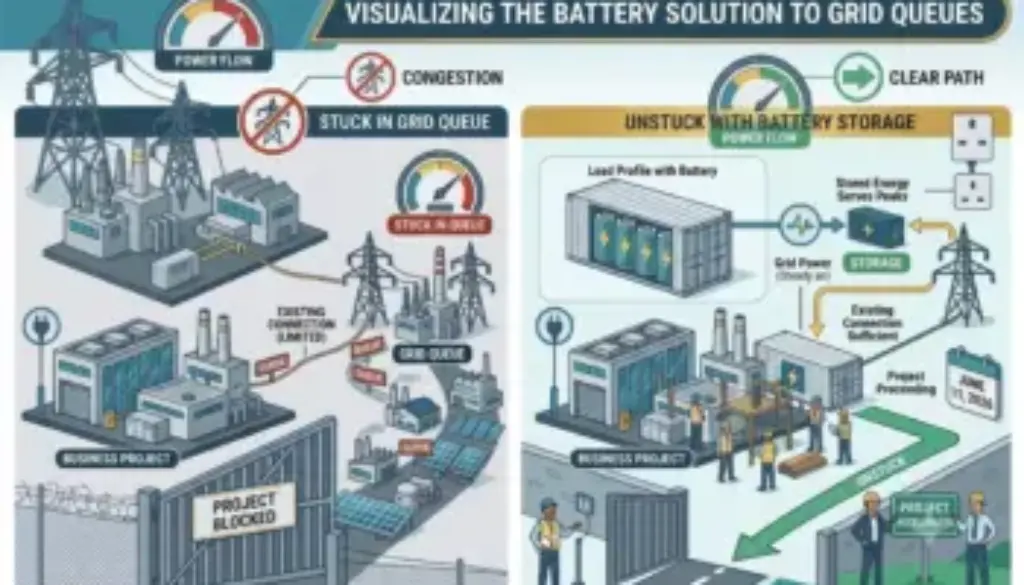
If your grid connection or upgrade is stuck in the queue, a battery can often get the project moving without it. The idea is simple: instead of drawing every peak from the grid, the site serves those peaks from stored energy, so the connection you already have is enough to keep going. For a business waiting on a Distribution Network Operator (DNO) reinforcement that is months or years out, a battery buffer can be the difference between starting now and waiting indefinitely. Containerised systems suit this job because they arrive largely pre-built and can be on site in days.
This guide explains why connections are stalling, how a battery buffers a site, the situations where it works, and where it does not replace the grid works entirely.
Why grid connections and upgrades are stalling in the UK
Demand on the grid is rising fast, driven by electrification, EV charging and new industrial load, while network reinforcement takes time to plan and build. The result is a queue. Businesses that want more power, or a new connection, are often told it will take far longer than their project can wait, or quoted a reinforcement cost that is hard to justify. The connection becomes the bottleneck, not the building, the equipment or the will to invest.
How a battery buffers your site from the incomer
A site’s grid connection has to be sized for its worst peak, even if that peak only happens for a short period each day. That is wasteful, and it is what forces expensive upgrades. A battery changes the maths. It sits between your loads and the incomer, charges steadily within the limits of your existing connection, and discharges hard during the short peaks. The grid only ever sees a smooth, modest draw. The peaks are covered by the battery, so the connection does not have to grow to meet them.
Three situations where this works
Adding a production line or load the connection cannot serve
When a site needs more power for new equipment than its connection can supply, the default answer is a grid upgrade. A battery can cover the additional peak demand instead, letting the new load come online while the existing connection stays as it is. This is exactly the pattern Pramac used for the Italian UPS manufacturer Borri, which needed more power for a new production line. Rather than wait for a grid reinforcement, it installed a containerised battery delivering 1,056 kW and 2,258 kWh, which covers peak demand and arbitrages energy across the day. The build programme stayed on schedule with no change to the incoming connection.
EV fast charging ahead of a DNO reinforcement
Public and fleet EV charging puts sharp, high peaks on a connection. Buffering the chargers from a battery rather than the incomer lets a charging site go live without waiting on a DNO reinforcement, and it protects the operator from the cost of a full grid upgrade. As the queue clears, the connection can be revisited, but the site is already earning in the meantime.
Temporary or redeployable storage tied to a build programme
A container is not a permanent fixture in the way a building is. That makes it useful for projects with a phased or temporary need: a battery can bridge a site through a development programme and then be redeployed elsewhere once the permanent connection arrives. The asset keeps working rather than becoming stranded.
Why containerised systems suit this job
When the answer to a grid problem needs to arrive quickly and at scale, a containerised system fits. It is engineered as a complete unit, battery, inverters, cooling and fire protection, in a 10ft or 20ft container, with up to 2,258 kWh and 1,080 kVA in a single 20ft unit. It is delivered on a lorry, craned onto a pad and commissioned in weeks, with less site work than a built installation. For grid-constrained projects, the speed and scale are the whole point.
What it does not replace: when you still need the grid works
A battery is a way around a connection bottleneck, not a way to ignore the grid entirely. If your site genuinely needs a larger permanent connection for sustained higher load, rather than to cover short peaks, the reinforcement still has its place, and a battery buys time and revenue while it is arranged. The right approach is to size the battery to the actual peak you need to cover, which is a question for the site and grid assessment rather than a rule of thumb.
Frequently asked questions
Why are grid connections taking so long in the UK? Demand is rising faster than the network can be reinforced, so new connections and upgrades sit in a queue that often outlasts a project’s timeline.
Can a battery let me add load without a grid upgrade? Often, yes. If the constraint is short peaks rather than sustained higher demand, a battery can cover the peaks so your existing connection is enough.
How does buffering EV chargers work? The chargers draw their sharp peaks from the battery rather than the grid connection, so the site can go live without a DNO reinforcement and without a connection sized for the worst peak.
Is containerised storage really faster to deploy? Yes. It arrives largely pre-built and is craned onto a pad and commissioned in weeks, with less site work than an installed system.
When do I still need the grid reinforcement? When the site needs sustained higher load rather than help with short peaks. A battery still buys time and revenue while that connection is arranged.
Generator Pro scopes the footprint, the grid connection route and the savings model before anyone commits. See the Pramac containerised battery storage range or read how a battery earns its keep in how a business battery pays for itself.