




How a Business Battery Pays for Itself
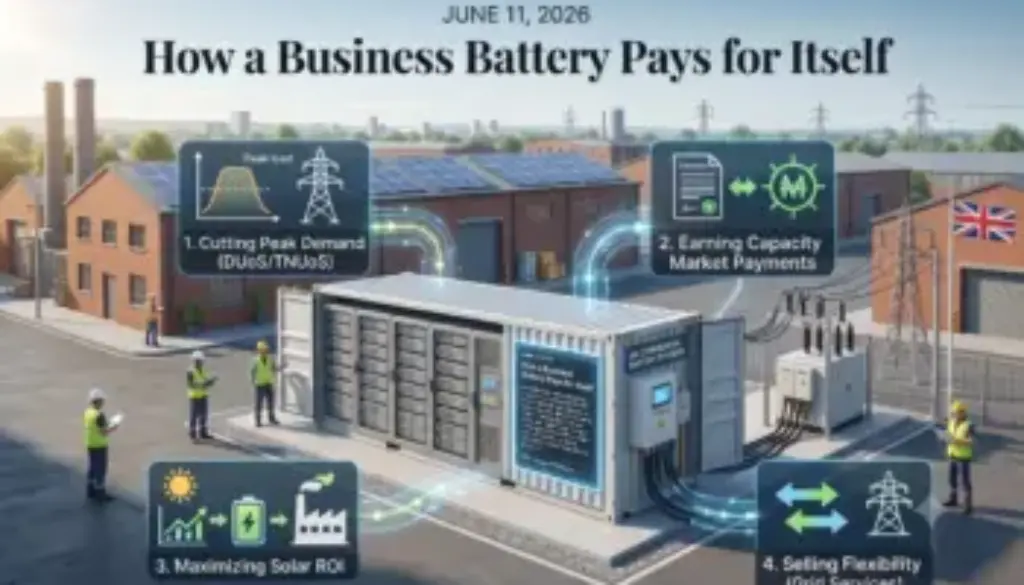
A commercial battery has four ways to earn its keep in the UK: it cuts peak demand charges, it earns Capacity Market payments, it gets a better return on your solar, and it sells flexibility back to the grid. Most of these start the moment the system is switched on rather than after a long payback period, and they can be stacked so the same battery earns from several routes at once. Which combination applies to your site depends on your tariff, whether you have solar, and whether you choose to enter the Capacity Market.
This guide explains each route in plain terms so you can see where the money comes from.
Cutting peak demand charges (peak shaving)
This is the most reliable saving, and it happens on every bill.
What the DUoS red band is
Most UK commercial electricity tariffs charge more for power used at certain times. The most expensive window is usually between 4pm and 7pm on winter weekdays, known as the DUoS red band. Power drawn from the grid in that window costs a premium. If your site is busy during those hours, a large part of your bill is set by what you use at the worst possible time.
Peak shaving means discharging the battery during that window so the site draws from stored energy instead of the grid. You shave the top off your demand peak, which is where the name comes from, and you move your draw out of the high-rate band. Done every working day, it adds up to a significant reduction.
Peak shaving versus load shifting
These two terms are often used interchangeably, but they are slightly different. Peak shaving is about reducing the height of your demand peaks, which cuts both the energy cost in expensive windows and, on some tariffs, the capacity charges based on your maximum demand. Load shifting is the broader idea of moving energy use from one time to another, for example charging the battery overnight when power is cheap and using it during the day. A battery does both at once: it shifts cheap overnight energy into the expensive daytime, and in doing so it shaves the peak.
Capacity Market revenue
The Capacity Market is a national scheme that pays assets to be available when the grid is under stress. National Grid runs annual auctions, known as T-1 and T-4 (one year and four years ahead of delivery), and a qualified battery can win a contract that pays a fixed amount for staying available to respond if it is called on. For the business, that is a regular payment for having the battery on standby, on top of the savings it makes day to day. Entering the Capacity Market is a choice rather than a requirement, and whether it suits you is part of the conversation when you size the system.
Getting the right price for your solar
If your site has solar, a battery changes the economics of it. Without storage, the surplus your panels produce in the middle of the day is exported to the grid and paid for under the Smart Export Guarantee (SEG), which returns only a fraction of what you pay to import power. That is a poor trade: you sell your own clean energy cheaply at midday and buy expensive grid power back a few hours later.
A battery holds that surplus instead. The solar you generate at midday is stored and used through the afternoon and evening shift, when grid electricity is at its most expensive. You are no longer buying back your own energy at peak price. This self-consumption is often worth far more than the export payment, and it makes an existing solar array considerably more valuable.
Flexibility services and the Balancing Mechanism
Beyond the Capacity Market, there is a growing set of schemes that pay batteries to provide short-notice flexibility to the grid. DNOs run Local Flexibility Markets that pay assets to help manage local network constraints. National schemes such as the Demand Flexibility Service (DFS) pay for reducing or shifting demand at peak times. And the Balancing Mechanism (BM) is the tool the system operator uses to balance supply and demand minute by minute, which batteries can participate in. These services sit on top of the bill savings as additional income, and the EMS handles the response automatically once the site is set up to take part.
Energy arbitrage: buy low, use high
Energy arbitrage is the practice of buying or storing energy when it is cheap and using or releasing it when it is expensive, capturing the difference in price. For a site on a tariff that varies through the day, the battery charges when wholesale prices are low and discharges when they are high, and the gap between the two is the gain.
Energy arbitrage versus peak shaving
The two overlap but are not the same. Peak shaving is about reducing demand charges by lowering your peak draw at specific high-cost times. Energy arbitrage is about exploiting the price difference between cheap and expensive periods, whatever those periods are. A site often does both with one battery: it shaves the demand peak to cut charges, and it arbitrages the daily price spread to cut energy cost. The EMS optimises across both rather than treating them separately.
Stacking the revenue: how the routes combine
The reason a commercial battery makes financial sense is that these routes are not mutually exclusive. The same system can shave peak demand charges, earn a Capacity Market payment for being available, store solar for self-consumption and respond to flexibility calls, all within the same week. The energy management system decides, hour by hour, which use is most valuable at any moment. No single route has to carry the whole case, because they add up. The exact mix that applies to your site depends on your tariff, your existing solar and whether you opt into the Capacity Market, which is worked out as part of the site survey before any commitment.
Frequently asked questions
What is peak shaving and how does it differ from load shifting? Peak shaving reduces the height of your demand peaks to cut charges in expensive windows. Load shifting moves energy use from one time to another, such as charging overnight to use by day. A battery does both at once.
What is the DUoS red band? A premium-priced window on most UK commercial tariffs, usually between 4pm and 7pm on winter weekdays, when grid power costs the most. Discharging the battery then avoids that premium.
How does the Capacity Market pay a battery? National Grid runs T-1 and T-4 auctions that pay assets to be available during grid stress. A qualified battery earns a fixed payment for staying on standby.
What is energy arbitrage and how is it different from peak shaving? Arbitrage captures the price difference between cheap and expensive periods. Peak shaving reduces demand charges by lowering your peak draw. A battery commonly does both.
Can these revenue routes be combined? Yes. The same battery can shave peaks, earn Capacity Market payments, store solar and provide flexibility, with the EMS choosing the most valuable use at any time.
Which routes apply to my site? That depends on your tariff, your solar and whether you enter the Capacity Market. It is worked out during the site survey.
Which revenue routes apply depends on your tariff, your solar and your site. Generator Pro works it out in the site survey before any commitment. See the Pramac commercial battery storage range or start with what a BESS is and how it works.