




How Long Will a Generator Run on a Tank of Fuel? Runtime and Fuel Consumption Explained
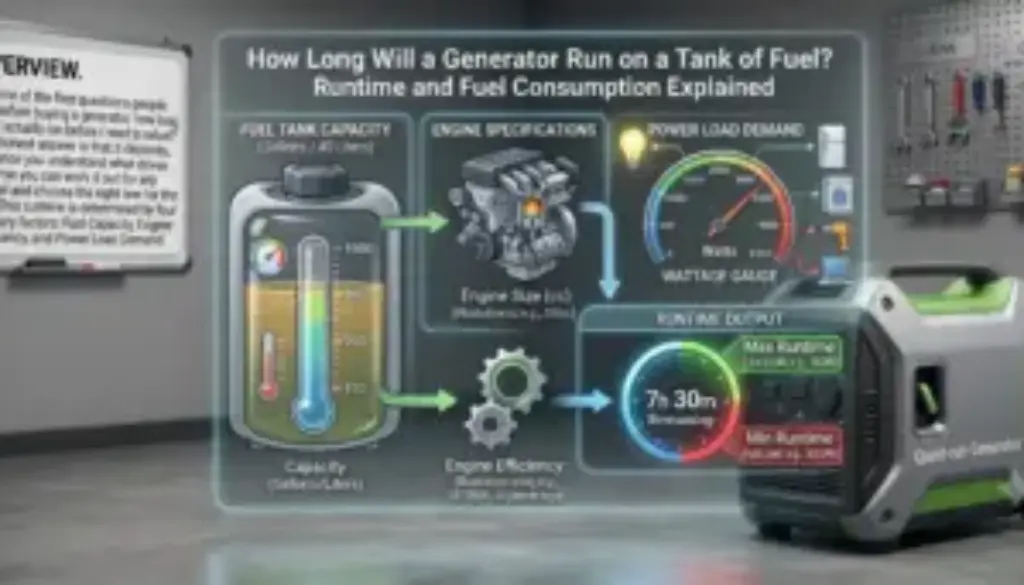
It is one of the first questions people ask before buying a generator: how long will it actually run before I need to refuel? The honest answer is that it depends, but once you understand what drives runtime you can work it out for any model and choose the right one for the job.
This guide explains what affects run time, gives typical figures by size, and shows you how to calculate it yourself.
The short answer
Most small portable generators run for somewhere between 4 and 10 hours on a tank at part load. Larger diesel and long-run models are built for much longer, and some will run for a full day or more without refuelling.
These are starting points, not fixed numbers. The same generator can run for very different lengths of time depending on how hard you work it.
What determines how long a generator runs
Load is the biggest factor
How much power you draw matters more than anything else. A generator running at a quarter of its capacity sips fuel. The same unit running flat out can empty its tank in a fraction of the time.
A good example from our own range is the Hyundai DHY8000SELR-T long-run diesel. It holds 30 litres and uses roughly 1.7 litres an hour at full load, which on paper would empty the tank in around 17 to 18 hours. Yet Hyundai quote up to 30 hours of running, because in normal use it rarely runs at full load. That gap between the two figures is the load factor in action.
The lesson is simple. Do not size a generator so tightly that it always runs flat out. A little headroom means longer run times and a longer engine life. Our guide to what size generator you need covers this in detail.
Tank size
The bigger the fuel tank, the longer the run, all else being equal. Long-run generators simply carry more fuel, sometimes with an enlarged tank or the option to feed from an external supply. The trade-off is weight and size.
Fuel type
Diesel engines are more fuel efficient than petrol, which is one reason they dominate standby and long-run duty. As a rough guide a diesel generator uses in the region of 0.3 litres of fuel for every kWh it produces. Petrol units generally use more for the same output. LPG is another option with its own trade-offs. Our guide to finding the right fuel for generators compares them, and you can browse diesel generators if runtime is your priority.
Inverter and eco mode
Many inverter generators have an eco or throttle-down setting that drops the engine speed when the load is light. Instead of running at full revs all the time, the engine slows to match demand, which cuts fuel use and extends run time considerably at part load.
Typical run times by generator size
The figures below are indicative. Always check the specification of the model you are interested in, because tank size and efficiency vary.
| Generator size | Typical use | Indicative run time at part load |
|---|---|---|
| 1 to 2 kW inverter | Camping, small tools, essentials | Around 4 to 10 hours |
| 3 to 4 kW | Home backup, market stalls | Around 6 to 12 hours |
| 5 to 7 kW | Home standby, small business | Around 8 to 14 hours |
| Long-run diesel (7 kW and up) | Standby, hire, continuous duty | Up to 24 hours or more |
As an example at the small end, a compact 2 kVA inverter generator with a 4.1 litre tank can run for up to around 10 hours at a quarter load, and far less if you push it harder.
How to calculate your generator’s run time
You can estimate run time with one simple sum:
Run time (hours) = tank capacity (litres) ÷ fuel consumption (litres per hour)
The catch is that fuel consumption changes with load, so use a figure for the load you actually expect. If a spec sheet gives consumption at full load, your real-world run time at part load will usually be longer.
Worked example: a diesel generator with a 30 litre tank using around 1.7 litres an hour at full load gives roughly 17 to 18 hours flat out. Ease the load and that stretches well beyond 24 hours.
If you want to work out what that fuel actually costs you, see our guide to the per-unit running cost of a generator.
How to make a generator run longer
- Manage the load. Only run what you need. Lower load means lower fuel use and longer running.
- Use eco mode if your generator has it.
- Choose a larger or long-run tank. If long runtime matters, buy for it from the start.
- Consider an external fuel supply where the model supports it, so you can top up without stopping.
If uninterrupted running is the goal, look at our continuous run generators, which are built for exactly this.
Can a generator run 24/7?
Yes, with the right model. Long-run and continuous-run generators are designed to run for extended periods, and some diesel units will manage a full day or more on a single tank. For truly non-stop operation you need to plan around two things: refuelling and servicing.
You cannot safely refuel a petrol generator while it is running or hot, so continuous petrol running has natural limits. Diesel long-run units, and setups with an external tank, get you much closer to round-the-clock power. Whatever you run, keep to the maintenance schedule, because oil and filters need attention during long duty cycles. Our guide to servicing a generator explains what to check.
Browse the continuous run range for models built to keep going.
Refuelling safely
Always let a petrol generator cool before refuelling. Never add fuel to a running or hot engine, because spilt petrol on hot parts is a fire risk. Store fuel in the correct containers, away from the generator and any ignition source, and keep the area well ventilated.
Choosing a generator for the runtime you need
Match the run time to the job. For camping, events or occasional use, a portable generator with a few hours per tank is usually plenty. For home backup you want something that will comfortably outlast a typical power cut, and our home generators are sized for that. For standby, hire or continuous duty, a long-run diesel generator is the sensible choice.
If you are not sure which fits your needs, get in touch and we will help you match runtime, size and fuel type to how you plan to use it.